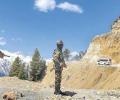
'India is not going to accept whatever the Chinese say. That is not going to happen.'

'If the Chinese intent is to be gauged based on its aggression in the South China Sea, greater forays in the Indian Ocean, a hawk's attitude towards Taiwan, flying its fighters repeatedly over the Senkaku islands in the East China Sea and creating strategic assets globally, there would be a requirement for strategic partnerships for India,' says Brigadier S K Chatterji (retd).
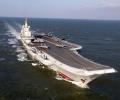
'The Chinese being focussed more seawards is definitely better for India with China being the looming threat along our land borders,' says Brigadier S K Chatterji (retd).

'The military aim in a future conflict, if it can't be avoided, should be to cause maximum damage to the adversary's war waging capability and capture limited amount of territory as a bargaining counter,' says Brigadier Gurmeet Kanwal (retd).

It will be interesting to see whether India-China border tensions figure during the deliberations of PLA deputies to the NPC and CPPCC, notes Jayadeva Ranade, the distinguished China expert and retired RA&W officer.

The paper also includes musing that SARS -- which hit China in 2003 -- could have been a man-made bioweapon deliberately unleashed by "terrorists".

'Open conflict would be a disaster for both China and India.'

'Clarifying that modernisation of national defence and armed forces should be completed by 2035, Xi Jinping asserted the goal is to make the People's Liberation Army a "world class force" that "can fight and win" by 2050,' points out former RAW officer Jayadeva Ranade.
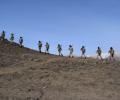
India brought in more troops after the destruction of two of its bunkers and "aggressive tactics" adopted by the Chinese People's Liberation Army

'The title of 'core' of the leadership gives Xi Jinping greater political authority at a time when China is beset by various problems as well as a slowdown in economic growth,' points out former RA&W officer Jayadeva Ranade.

The coming together of the Quad and the Australia-UK-US grouping would be a formidable adversary, moving toward the creation of a 'thousand ship navy' that reins in the PLA navy in the Indo-Pacific.
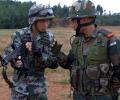
General Rawat said Indian forces will face the PLA troops if they come again in Doklam.

India must break out of this strategic triangulation between China and Pakistan. We need to settle our issues with one of the two, notes Shekhar Gupta.
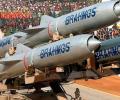
The Philippines, confronted with Chinese bullying in the South China Sea, have become the first foreign military to order the shore-based, anti-ship cruise missile.
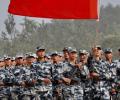
Even though troops of India and China have disengaged at three locations in Eastern Ladakh, the Indian side is clear that the tensions on the borders would be done away completely only when the People's Liberation Army de-inducts more than 10,000 troops along with artillery and tank regiments deployed on its side of the Line of Actual Control near the Indian territory.

Official sources said withdrawal of tanks and other armoured elements from certain friction points is nearing completion while pulling back of troops from the North bank areas is being undertaken.

Impeded supplies have fuelled price rise in the affected regions, where authorities are coming under increasing strain in coping with the effects of the disaster and keeping the people calm, particularly millions of stranded passengers whose most-cherished once a year trip on Chinese New Year is facing uncertainty.

'Intrusions by PLA troops in the Ladakh sector are more in number than elsewhere and this region is now likely to remain an area of enhanced Chinese interest,' warns China expert Jayadeva Ranade.

Major General Sujan Singh Uban, a legendary veteran of the Second World War, was a natural choice to raise, train and command the Special Frontier Force and mould them into a well oiled fighting machine, recalls his son Inspector General Gurdip Singh Uban (retd), who led SFF troops during the Kargil War.

The incident occurred on March 8 when a platoon of at least 11 PLA men led by a colonel-rank officer crossed over the imaginary LAC.

Among others, China is developing the strategically located Gwadar port in Balochistan, which is aimed towards having a military presence, says a Pentagon report

Coming ahead of the transition of power from Donald Trump's administration to President-elect Joe Biden's administration after the November 3 US presidential election, the detailed policy document highlights that China is undermining the security, autonomy and economic interests of many nations in the region.

Amid the South China Sea tensions, Chinese military on Saturday kicked off large scale military exercises pressing troops from the five theatre commands of the People's Liberation Army simulating real battle conditions.
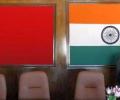
The sources said the focus of the talks was to take forward the disengagement process in friction points like Hot Springs, Gogra and Depsang in eastern Ladakh.

The entire gamut of China's activities is aimed at keeping India on tenterhooks, cause fatigue to its troops and keeping its security system unstable, so that it cannot play a meaningful role in international geopolitics as an effective partner of the US and Japan, observes Lieutenant General Syed Ata Hasnain (retd).

'The potential of one such LAC engagement going out of control and leading to heavy casualties cannot be ruled out,' warns Lieutenant General Syed Ata Hasnain (retd).
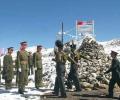
'We will not accept these misadventures by the Chinese.'
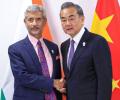
The joint statement said Jaishankar and Wang agreed that both sides should take guidance from the series of consensus reached between leaders of the two countries on developing India-China relations, including not allowing differences to become disputes.

'China's latest defence White Paper has been issued against the backdrop of the upgraded Sino-Pakistan strategic relationship which has impinged on India's sovereignty and territorial integrity, and Beijing's continuing intransigence on tackling the issue of the disputed border or intrusion by PLA troops,' says Jayadeva Ranade.
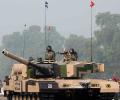
Senior Colonel Liu Degang said the Arjun tank is "very good" and suits Indian conditions.

Indian Army officers, serving and retired, will tell you that the one thing that makes the Indian soldier singularly unique is his josh and jazba.

Why is China's supreme leader promoting Han Chauvinism so aggressively, asks Claude Arpi.

The network could serve in all-weather conditions, Fang Lei, of the air force headquarters of the Chinese People's Liberation Army, was quoted as saying by the state media.

Arpi deserves to be complimented for the commitment and hard work that have gone into this production. The frustrations of seeking reliable documentation from the catacombs of the Indian bureaucracy did not deter him from going after the best information available, and the result is one that he can take much satisfaction in. Ambassador Prabhat P Shukla, Member Advisory Council, Vivekananda International Foundation, reviews Claude Arpi's The End of an Era: India Exits Tibet.
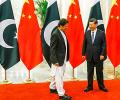
'If a 'two-front war' develops, Iron Brother may only turn out to be a drag on the PLA, since Pakistan is in no position to wage a war with India,' argues Ambassador M K Bhadrakumar.

The sixth chapter of the Joint Military Training Exercise "Hand in Hand" between India and China are ongoing in Pune in Maharashtra with a focus on "transnational terrorism" and counter-terrorism operations in "semi-urban scenarios."

'There are certain critical deficiencies like shortage of fighter squadrons and force multipliers which must be addressed on priority to retain our combat edge'
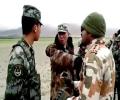
'During disengagement, you don't find violence.' 'And that, too, the killing of a commanding officer.' 'This indicates that this is more serious than previous incidents.'

The Tibetan nation still lives under the yoke of the Chinese Communist Party, and Beijing today has a guilty conscience; this creates a great uneasiness for Xi Jinping and his colleagues observes Claude Arpi.
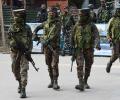
The days of a thousand cuts are over. These mini wars will remain under the threshold of undeniable war, but will escalate closer to that threshold when their big brother pushes in. Chinese aggression has changed the matrix, the strategies, and surely the objectives too, warns David Devadas.
 © 2026 Rediff.com - Advertise with us - Disclaimer - Privacy Policy - Sitemap - Feedback - About us - Terms of use - Grievances